
Burner turndown and efficiency are often discussed together, but they describe different aspects of burner and heating system performance. Turndown is the ratio of a burner’s highest firing rate to its lowest. This is often limited by the burner’s ability to have combustion that is as low as possible while maintaining reliable flame signal and emissions that pass requirements. Efficiency on the other hand is how much of the fuel’s energy becomes usable heat in an application. This page breaks down each term, shows typical ranges, and explains how they work together when operating direct and indirect fired systems.
Burners can be designed with many combinations of turndown and efficiency, depending largely on the application and cost requirements. Gas train components, control systems, burner design, and installation conditions all influence overall performance. For example, a batch oven that only needs to reach temperature once per hour may not require the same level of continuous modulation as a rooftop makeup air unit.
Midco offers burners with various turndown capabilities. See examples in Table 1. Midco’s offerings can be customized to suit your specific requirements. All of Midco’s offerings can be found here.
| Table 1 – Example Midco Burners and Turndowns | ||
| Burner Series | Image | Turndown |
| Heated Makeup Air (HMA) |  |
30-1 |
| Midco High Turndown (MHTD) |  |
10-1 |
| Incinomite |  |
1-1 (single rate) |
What is Burner Turndown?
Turndown refers to the ratio of the maximum and minimum firing rates of a burner system. This concept is important because it indicates how flexible the system is regarding adjusting its output to match varying demands. The gas flow and airflow are adjusted accordingly to maintain proper combustion and performance within the range.

- Maximum vs. minimum firing rate: The system operates within a specific range, allowing for reduced or increased output as needed. Burners can have a turndown as low as 1:1 for on/off burners and as high as 30:1 for modulating air/gas burners.
- Example: V10 at 10” inlet pressure:

- Gas flow and airflow: As the firing rate changes, the gas flow and/or airflow must be adjusted to ensure efficient combustion and safe operation. A ratio regulator is used to maintain this ratio on some burners such as the VA and MHTD series. Other methods include utilizing known setpoints of blower speeds and actuating ball valve positions.

What is Burner Efficiency?
Efficiency measures how effectively a system converts fuel into usable heat for a specific application. Different firing methods and types of efficiency play a role in determining overall performance.
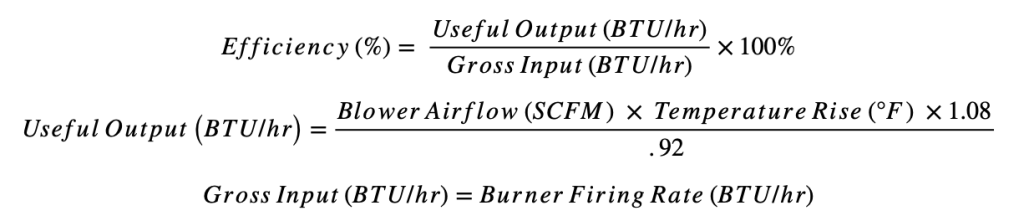
- Direct fire vs. indirect fire: Direct fire systems transfer heat directly to the application, whereas indirect fire systems use an intermediate medium.
- Amount of heat used: Efficiency depends on how much of the generated heat is actually applied to the intended process or product. This is affected by the amount of airflow from the combustion blower and the process heat blower.
- Thermal vs. combustion efficiency: Thermal efficiency evaluates the heat transfer to the application while combustion efficiency assesses how completely the fuel is burned.
- Typical indirect fire thermal efficiency: 80-81%
- Typical direct fire thermal efficiency: 92%
Temperature Controls and Their Impact on Efficiency
Temperature controls are important for maintaining efficiency, especially at lower firing rates. Common control methods such as on/off, proportional, and proportional-integral-derivative (PID) respond to process temperature changes by adjusting burner operation. At low fire, precise control can be more difficult. For example, basic on/off controls may cycle frequently which increases standby losses and reduces overall efficiency.
Advanced modulating controls like PID allow the system to respond more smoothly to small changes in demand. This reduces unnecessary cycling and maintains steadier temperatures. However, at very low firing rates, burners may need additional excess air to maintain flame stability which can increase flue losses and slightly reduce combustion efficiency. As a result, low-fire efficiency depends on the control strategy, the burner’s modulation capability, and the combustion stability requirements. Systems with well-tuned temperature controls typically perform better under variable load conditions by improving stability and reducing wasted energy.
RTC Solutions DFC+ Control Features: Automatic thermostat with deadband and hysteresis. The DFC+ includes an automatic inlet thermostat that helps the system respond efficiently to changing outdoor air conditions. The heating deadband can be programmed from 2°F to 10°F, allowing the burner to stay off when the inlet temperature remains close to the system setpoint. Heating starts when the inlet temperature falls below the setpoint minus the programmed deadband. After heating is active, the built-in 2°F hysteresis helps prevent short cycling by requiring the temperature to move back toward the setpoint before the burner shuts off. This reduces unnecessary burner starts, improves temperature stability, and supports efficient operation under variable load conditions.
On/Off (Cycling) vs. Low Fire (Modulating) Burner Efficiency Comparison
| Table 2 – On/Off vs. Low Fire Burner Efficiency Comparison | ||
| Factor | On/Off (Cycling) Burner | Low Fire (Modulating) Burner |
| Average Load Matching | Meets part load by cycling between 0% and 100% fire (or high/low fire if two-stage) | Meets part load by continuously reducing firing rate (e.g., 10–100% depending on turndown) |
| Cycling/Standby Losses | Typically higher due to frequent starts/stops, purge cycles as required, and heat loss between cycles | Typically lower since the system can stay lit and track demand without repeated shutdowns |
| Combustion Efficiency at Low Load | Often near “rated” combustion performance when firing, but overall efficiency can drop if cycling is frequent | Can be slightly lower at very low fire if excess air must increase for flame stability (higher flue losses) |
| Temperature Stability (see Figure 1) | Wider temperature swings near setpoint; overshoot/undershoot is common, especially with simple controls | Tighter temperature control with proper modulation and PID tuning; reduced overshoot |

Figure 1 – Firing Rate Comparison Example
An on/off burner may operate at full fire for 20–30 minutes per hour then remain off for the balance of the cycle. This timing is typically driven by a fixed schedule or by the temperature dropping below the deadband. Because the deadband allows a wider temperature swing, on/off systems can overheat the space and then require additional reheating as the temperature falls. By contrast, a modulating burner can often steadily run at 40–50% output, maintaining tighter temperature control while reducing cycling. Modulating can also improve efficiency and safety by limiting startups and reducing the need for pre- and post-purge cycles that remove useful heat from the system.
| Table 3 – Fuel Usage for a Burner When Using On/Off vs. Modulating | |||
| Time (minutes) | On/Off (BTU/hr) | Modulating (BTU/hr) | Cumulative Savings (BTU/hr) |
| 10 | 10,000,000 | 4,363,110 | 5,636,890 |
| 20 | 10,000,000 | 8,003,982 | 1,996,018 |
| 30 | 20,000,000 | 12,216,298 | 7,783,702 |
| 40 | 20,000,000 | 16,235,235 | 3,764,765 |
| 50 | 30,000,000 | 19,992,577 | 10,007,423 |
| 60 | 30,000,000 | 24,352,124 | 5,647,876 |
FAQ
What is burner turndown? Burner turndown is the relationship between a burner’s maximum firing rate and minimum stable firing rate. For example, a 10:1 turndown burner can operate at one-tenth of its maximum output while maintaining stable combustion, proper airflow, and reliable flame signal.
Does higher burner turndown mean better efficiency? Not always. Higher turndown can improve system efficiency by reducing cycling and helping the burner match the heating load more closely. However, efficiency also depends on combustion stability, excess air, heat transfer, control strategy, installation conditions, and whether the system is direct fired or indirect fired.
How does burner modulation reduce fuel usage? A modulating burner adjusts its firing rate to match demand instead of cycling fully on and off. This can reduce purge losses, limit temperature overshoot, improve temperature stability, and lower overall fuel usage in applications with changing heat loads.
What is the difference between combustion efficiency and thermal efficiency? Combustion efficiency measures how completely the fuel is burned and how much heat is lost through the flue. Thermal efficiency measures how much of that heat is actually transferred to the process, air stream, or application. A burner can have strong combustion performance while the overall system efficiency depends on how effectively the heat is used.
When should an application use a high turndown burner? A high turndown burner is useful when the heating load changes frequently or when tight temperature control is important. Common examples include heated makeup air systems, industrial ovens, process heating equipment, and other applications where continuous modulation can reduce cycling and improve operating stability.